






The head librarian summoned the department heads to a conference room in early June of 2024. She informed us that the board of trustees had voted to shutter the library at a separate school in Manhattan as part of a larger affiliation agreement, and that we would now provide it with library services. Then came the shoe-drop. Our staff was instructed to empty the New York building of all of its contents and make it ready for renovation…and they wanted it completed by Christmas. Over 200,000 open stack books, over 20,000 rare books, 1100 linear feet of archival material, plus 6 offices full of administrative records, with 6 months to get it done – while having to continue to run our current departments. Thus began a headache of a project. Making matters more difficult, the head librarian announced that she was retiring at the end of the month. Yay!
Fortunately, our Technical Service Librarian was a former employee of Iron Mountain, a company that specialized in transferring large library collections. He was quickly assigned the role of project manager and began to plot out the workplan via Trello. Through that project management software, we each were given our assignments, the dates for our travel, the timeframe for our department work, contractor agreements, outstanding issues, and reports. Each of us was given a section of this mammoth undertaking, and like the elephantine proverb, we ate it one bite at a time.
All of that to say that we will all face massive projects. Sometimes they are planned, and many times, they are not. Having a basic knowledge of project management is a necessary skill, and even more so as historians engage more with inter-disciplinary research. Digital history work is rooted in intersectional collaboration that combines many forms, including human-to-human, human-to-machine, and machine/material-to-machine/material. (1) The complexity of these interactions require appropriate planning, workflows, and reporting to ensure the system runs smoothly. The story above serves as an example.Though paired down to a smaller scale, our class projects will be accomplished the same way.
Perhaps it was because of the experience discussed above or my time as an archivist, I found myself nominated to be my group’s project manager. We settled on a topic that combined our research and learning interests, set up our report out time, and agreed on early tasks. My first task was to get our Basecamp set up and provide a rough roadmap for us. To get us started, I went to Claude AI and gave it the following prompt.
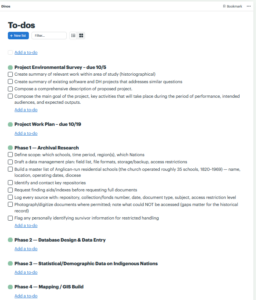
It produced a document with seven phases that I reviewed, adapted and edited to meet the needs of our research and learning outcomes. I then went to Basecamp and created a workplan in the To-Do section that looked like this >>>

Using my work experience, I listed out the tasks that need to be completed for archival research. I then turned my attention to NDH’s Notice of Funding Opportunity to craft the tasks needed to complete the Environmental Survey. It states that the survey should “provide a concise summary of relevant workwithin your area of study, including work that is technically a methodology logically similar, and its relationship to your proposed project… discuss existing software that addresses similar questions… describe existing humanities projects similar to yours.” (2) I translated this into the four tasks listed in the image.
While I still have plenty to do to ensure that this project is flowing the way it should, I believe we are off to a good start.
1. Gabriele Griffin and Matt Steven Hayler, “Collaboration in Digital Humanities Research – Persisting Silences,” Digital Humanities Quarterly 12, no. 1 (2018), https://dhq.digitalhumanities.org/vol/12/1/000351/000351.html [AI assisted citation]
2. National Endowment for the Humanities, Digital Humanities Advancement Grants: Notice of Funding Opportunity, funding opportunity no. 20240111-HAA (Washington, DC: National Endowment for the Humanities, 2023), https://www.neh.gov/sites/default/files/inline-files/20240111-HAA%20Digital%20Humanities%20Advancement%20Grants%202024%20%281%29.pdf [AI assisted citation]
2 responses to “The Project of Managing Projects”
Denton, the anecdote you provide about the New York library to introduce your connection to project management really showcases why these tools are essential to both an individual and group project! I actually did not realize you used Claude to aid in our planning discussion for the group project, and I am really impressed with the human-machine collaboration at work
Denton,
Firstly, I would like to acknowledge that I love the layout of your blog. I think this is my first time visiting it.
It’s important to hear real-world examples of project management, as talking about concepts exclusively in an academic environment or simply as an idea can often diminish the importance of the example, causing a disconnect from a true understanding of a concept. Intersectional collaboration, as you mentioned in DH projects, is essential, as it is in any other form of management.