







This optional module hits close to home. As an archivist, I find myself in the lineage of a long line of data brokers and record mediators. Many times my profession gets blamed for things beyond our control. An extreme example is that we can not control that Julius Caesar burned the Library of Alexandria down. Where sources end up is not always our fault, and we are certainly not responsible for scholars not doing the work of deep research in our repositories. However there are certain negative actions we cannot deny. Archivists have too long acted as gatekeepers to sources. We have used the veneer of expertise to ignore and silence voices that contradict our systems of organization, and we have engaged in institutional biases reflecting colonialism, sexism, racism, and oppression. As Sharon Block pointed out, this is not a just individual actions, but “is about structural failings.” (1)
Repositories are human institutions, as such they reflect human culture, values, and biases. Our cataloging practices, subject listings, and systems of organization are not the product of neutral computations, but are designed and reinforced through human decisions. (2)While professional standards, ethics, and practices try to reduce harmful use and description – this is no guarantee that such harm will not be done. (3) As S. L. Ziegler put it, “a thin legalistic understanding of what should and should not be shared will never be robust enough to ensure we do not harm people we represent.” (4) Even people that wish to be more diverse in their data descriptions can fall victim to institutional bias. I will use an example from my library’s catalog.
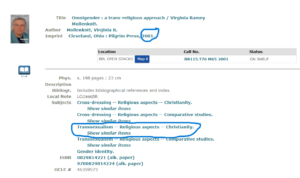
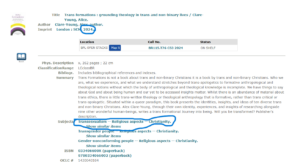
This first image is the catalog entry for a 2001 book examining religion from a transgender perspective. If you read the subject headings, you can see how they would be viewed as offensive to many trans-people. These subjects are not local categories, but subject headings from the Library of Congress. Now, the book was published in 2001. Maybe one could excuse this as lagging behind the evolution of language. But pay attention to the circled subject, then look at the second picture. This book was published in 2024, and yet one of the problematic subjects continued. Why? I don’t know. Perhaps the LoC is still using it, or maybe the cataloger thought they needed at least one cross reference and selected the one they thought was the least problematic. No matter the reason, it begs us to ask Ziegler’s question: “If the people described in our data could see our project, would we be as eager to work on this project?” (5)
Catalogers, librarians, archivists, and data brokers hold great power in the descriptions we create. They influence both who accesses materials, and how they are interpreted. We in the profession need to question the biases that we write into the data, and historians must question what values, worldviews, and systems of oppression have been initially or unintentionally written into the data fields.
1. Sharon Block, “Erasure, Misrepresentation and Confusion: Investigating JSTOR Topics on Women’s and Race Histories,” Digital Humanities Quarterly 14, no 1 (2020), http://digitalhumanities.org/dhq/vol/14/1/000448/000448.html.
2. Block, “Erasure, Misrepresentation and Confusion.”
3. S.L. Ziegler, “Open Data in Cultural Heritage Institutions: Can We Be Better Than Data Brokers?” Digital Humanities Quarterly 14, no 2 (2020,) http://digitalhumanities.org/dhq/vol/14/2/000462/000462.html.
4. Ziegler, “Open Data in Cultural Heritage Institutions.”
5. Ziegler, “Open Data in Cultural Heritage Institutions.”