






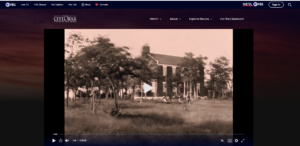
Our small group on Monday discussed what makes storytelling digital versus other methods. Pete pointed out that a board definition would include things like Ken Burns documentaries, that they are passively consumed. Should that be considered digital? Our group came to the consensus that there needed to be an element of engagement and agency on the part of the audience for the digital element to truly be effective. Therefore, watching a documentary on the PBS website may not be considered digital history if the result is the same as watching it on television. (1)
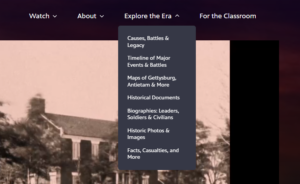 The Explore the Era menu breaks down the documentary into separate categories. This allows the audience to consume the history at their own pace and be selective about what they want to explore. This agency is not readily available via the normal film media, but is an asset of the digital model. Though it should be noted that DVD technology did experiment with interactive menus and bonus features in the early 2000s. This experience customization is a key element and strength of digital storytelling.
This is not a full exploration of the website of Ken Burns’ Civil War. However, I do what to point out that digital storytelling allows people to interact with historical figures, data, and documents in ways that are difficult in a traditional monograph or require seeking out experts located in museums and archives. In addition to the pedagogical implications of that, there is also the difficulty of access. Many historians write primarily for historians, which makes it difficult for the typical audiences to engage with the material. And repositories often require people to take time off work, travel, and pay entry fees. This has the effect of restricting access to those with disposable incomes. Plus, there is the gate keeping that has too long plagued the archives profession.
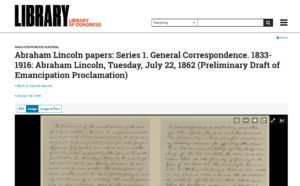
However, a digital approach democratizes history access. The PBS site, for example, allows visitors to read primary sources and links many of them to the digitized copies held by the Library of Congress. This may be the only way some people may ever be able to see these documents. Think about what viewing them would entail. First you would have to take the required time off work to travel. Then you would need to pay for a plane ticket to D.C., and a hotel. You would need to have already contacted the Library of Congress to get permission to view the documents, something that is not guaranteed. You would have to register as a borrower, complete the required documentation, and wait for the documents to be delivered. Then you would be given a limited amount of time with them, along with strict rules about what you were allowed to do regarding handling and photographing. To a historian, this is just standard procedure, but to the average American, it is an undue burden. Heck! Even historians have to beg for grant funding to be able to do the work. Digital storytelling levels the playing field, and (in my opinion) it is the freedom of access that truly makes something Digital History.
1. Class Discussion, “Digital Storytelling,” Clio Wired, 0ctober 10, 2026.
One response to “Digital Storytelling”
Thanks for sharing a cool feature I didn’t know existed–and of course it’s PBS. Something like this could definitely be utilized by the research team of a documentary (or even historical drama!) to both cite their sources and invite the audience to engage more deeply with the history of the film instead of watching passively. I hope for a world where well-researched, genuinely engaging films are used in classrooms and reach general audiences instead of AI-created “historical vlogs.”