








Made available courtesy of piracy
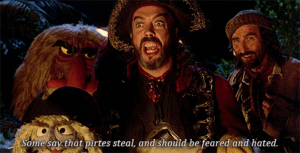
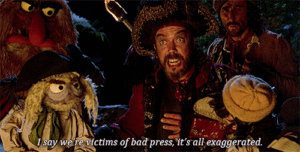
In Jim Hension’s Muppet Treasure Island, the late legendary actor, Tim Curry, gave a rousing defense of piracy in the song A Professional Pirate. However, a group of puppets (Curry included) are not the only ones to defend piratical acts and the people that commit them. In Villains of All Nations, historian Marcus Rediker gave a Marxist labor interpretation of pirates and argued that they are better understood as an early modern example of anti-government/anti-capitalism unionization.(1) Piracy thrives where injustice systems reign, or as UVA’s Brandon Butler put it; “‘Piracy seems to come in when there’s a market failure.’”(2)
Made available courtesy of piracy
In class we discussed how the current copyright laws and academic publishing systems have made it difficult for people to access information and for scholars to present new findings to people that would be interested in their findings. Ever advancing technology makes evading these issues easier to do, and conversations on the ethics related to piracy more common – even among librarians and archivists. Resnick and Belluz called these professionals a “disparate band of revolutionaries is waging war on the scientific publishing industrial complex.”(3) These professionals probably would not like being called pirates. But I think they are certainly privateers, which are just pirates that operate within established systems. They advocate for open access, inform students and researchers of…unconventional… ways of finding publications, and turning a blind eye to the amount of copies people make.
Here is a completely, absolutely, in-no-way-true…example. A student came into the library with an accommodation from the academic affairs office. They were to be given access to e-versions or pdfs of all their required readings. They were given the permalinks to the ebooks in the catalog and memberships were paid to allow them access to various sites that held others. However, there was one book that could not be accessed in any way as a digital resource. I was left with a choice: tell the student they would just have to make due, or have the physical copy scanned and made available to the student. All I can say is that the accommodation was fulfilled.
The reality is that everyone is going to be made to make a decision that may engage with piracy. This is because we live in an unjust system, and piracy thrives within them.

Made available courtesy of piracy
1. Marcus Rediker, Villains of All Nations: Atlantic Pirates in the Golden Age (Boston: Beacon Press, 2004).
2. Brian Resnick and Julia Belluz, “The War to Free Science: How Librarians, Pirates, and Funders Are Liberating the World’s Academic Research from Paywalls,” Vox, June 10, 2019, https://archive.is/20190610151251/https://www.vox.com/the-highlight/2019/6/3/18271538/open-access-elsevier-california-sci-hub-academic-paywalls#selection-945.5-945.100
3. Resnick and Belluz, “The War to Free Science.”
4 responses to “Privateers, Pirates, and Buccaneers…Oh my!”
Denton – first, I need to ask if you were one of the pirates in that first picture (story please!). Next, I appreciate your distinction between pirates and privateers, noting that professors and librarians may be the latter. When there’s a failure and injustice in the system, individuals will use what agency they have to address the failure and feel less dissonance.
I was the Lord Mayor for the Georgia Renaissance Festival for five years.
In Elizabethan times, what the English called “privateers” the Spanish called “pirates.” This was especially iffy when England and Spain were nominally at peace, and the Englishman Drake was out capturing Spanish ships. Privateers had at least the backing of a sovereign country, however slim an excuse that is. I don’t believe that is the case for some of the more “unconventional” ways of circumventing copyright.
Hi Denton,
I absolutely love the Muppets Treasure Island intro, and the MD Ren Fest picture! I also think your totally hypothetical example is really great for illustrating your point. People will respond to a need by fulfilling that need to the best of their ability, and companies and systems that create needs don’t really think about the people in their audience. Except for the Muppets, of course. Jim Henson would never.